
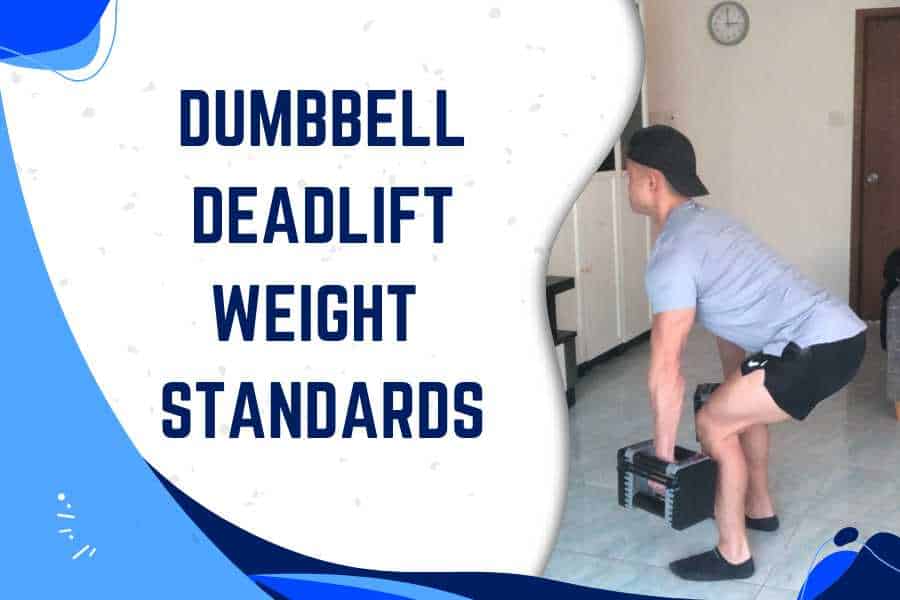
Deadlifting is one of the best dumbbell exercises to build muscle when you are lifting a sufficient amount of weight. Below, I share dumbbell deadlift weight standards that allow you to benchmark your performance against yourself and others.
A respectable dumbbell deadlift for the average beginner is around 40% of the individual’s body weight for a single repetition. Intermediates should be able to lift 110% of their body weight, and advanced lifters should be able to lift 150% of their body weight.
The weight standards revealed below will help you determine what is a respectable weight to be deadlifting and how much weight you should be lifting based on your gender, body weight, and training experience.
- How To Use These Dumbbell Deadlift Weight Standards
- Beginner Dumbbell Deadlift Weight Standards
- Intermediate Dumbbell Deadlift Weight Standards
- Advanced Dumbbell Deadlift Weight Standards
- How Good Is Your Dumbbell Deadlift Vs Others?
- Factors Affecting How Much Weight You Can Dumbbell Deadlift
- 5 Reasons Why Your Dumbbell Deadlift Weight Is Below Average
- 5 Tips To Improve Your Dumbbell Deadlift Weight
- Other Weight Standards For Dumbbell Deadlift Muscles
- Conclusion
How To Use These Dumbbell Deadlift Weight Standards
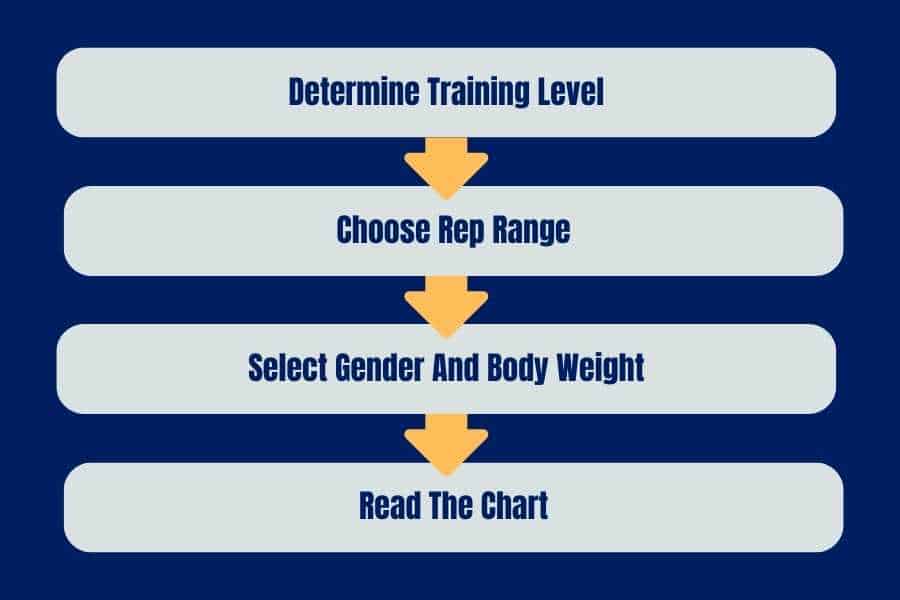
1) Determining your training level:
- Beginners have practiced an exercise for 1-12 months.
- Intermediates have practiced an exercise for 12-36 months.
- Advanced lifters have practiced an exercise for 4 years or more.
2) Choosing your rep range:
The weight standards are given for:
- 1-rep max (1RM)- this is the maximum amount of weight you can lift for a single repetition. This is often used as a strength standard.
- 6-10 working reps- this is generally considered to be the ideal rep range for building muscle.
3) Selecting your gender and body weight:
- Dumbbell deadlift standards are revealed for common body weights.
- Male dumbbell deadlift standards are given.
- Females should use a 75% conversion (multiply the weight standard by 0.75).
4) Reading the charts:
- Weight standards are given as lbs on the top and kg on the bottom.
- Weights are for two dumbbells combined.
- If you’re lifting at or above the weight standard for your given training level, body weight, and gender, then you are lifting a respectable amount of weight.
Beginner Dumbbell Deadlift Weight Standards
Here’s how much weight you should be dumbbell deadlifting as a beginner:
| Bodyweight | 1-rep max | 6-rep max | 7-rep max | 8-rep max | 9-rep max | 10-rep max |
|---|---|---|---|---|---|---|
| 120lb 54kg | 42lb 19kg | 35lb 16kg | 34lb 16kg | 34lb 15kg | 33lb 15kg | 31lb 14kg |
| 150lb 68kg | 60lb 27kg | 50lb 23kg | 49lb 22kg | 48lb 22kg | 47lb 21kg | 44lb 20kg |
| 200lb 91kg | 90lb 41kg | 76lb 34kg | 74lb 33kg | 72lb 33kg | 70lb 32kg | 66lb 30kg |
| 250lb 113kg | 116lb 53kg | 97lb 44kg | 95lb 43kg | 93lb 42kg | 90lb 41kg | 85lb 38kg |
| 300lb 136kg | 140lb 63kg | 118lb 53kg | 115lb 52kg | 112lb 51kg | 109lb 50kg | 102lb 46kg |
Generally speaking, beginners should be able to dumbbell deadlift 35 to 45% of their body weight for a single repetition (1-rep max).
Unsure whether or not to include deadlifts in your program? You can check out my other post for a full explanation of the full benefits of deadlifting!
Intermediate Dumbbell Deadlift Weight Standards
Here’s how much weight you should be dumbbell deadlifting as an intermediate:
| Bodyweight | 1-rep max | 6-rep max | 7-rep max | 8-rep max | 9-rep max | 10-rep max |
|---|---|---|---|---|---|---|
| 120lb 54kg | 140lb 63kg | 118lb 53kg | 115lb 52kg | 112lb 51kg | 109lb 50kg | 102lb 46kg |
| 150lb 68kg | 174lb 79kg | 146lb 66kg | 143lb 65kg | 139lb 63kg | 136lb 62kg | 127lb 58kg |
| 200lb 91kg | 220lb 100kg | 185lb 84kg | 180lb 82kg | 176lb 80kg | 172lb 78kg | 161lb 73kg |
| 250lb 113kg | 260lb 118kg | 218lb 99kg | 213lb 97kg | 208lb 94kg | 203lb 92kg | 190lb 86kg |
| 300lb 136kg | 296lb 134kg | 249lb 113kg | 243lb 110kg | 237lb 107kg | 231lb 105kg | 216lb 98kg |
Generally speaking, intermediates should be able to dumbbell deadlift 100 to 115% of their body weight for a single repetition.
Advanced Dumbbell Deadlift Weight Standards
Here’s how much weight you should be dumbbell deadlifting as an advanced lifter :
| Bodyweight | 1-rep max | 6-rep max | 7-rep max | 8-rep max | 9-rep max | 10-rep max |
|---|---|---|---|---|---|---|
| 120lb 54kg | 214lb 97kg | 180lb 82kg | 175lb 80kg | 171lb 78kg | 167lb 76kg | 156lb 71kg |
| 150lb 68kg | 254lb 115kg | 213lb 97kg | 208lb 94kg | 203lb 92kg | 198lb 90kg | 185lb 84kg |
| 200lb 91kg | 310lb 141kg | 260lb 118kg | 254lb 115kg | 248lb 112kg | 242lb 110kg | 226lb 103kg |
| 250lb 113kg | 356lb 161kg | 299lb 136kg | 292lb 132kg | 285lb 129kg | 278lb 126kg | 260lb 118kg |
| 300lb 136kg | 398lb 180kg | 334lb 152kg | 326lb 148kg | 318lb 144kg | 310lb 141kg | 291lb 132kg |
Generally speaking, an advanced lifter should be able to dumbbell deadlift 130 to 180% of their body weight for a single repetition.
How Good Is Your Dumbbell Deadlift Vs Others?
Here’s the percentage of people who can dumbbell deadlift their own body weight:
| Dumbbell Deadlift 1RM Weight (As A Fraction Of Bodyweight) | % Of People Who Can Do It |
|---|---|
| 0.10x | 100% |
| 0.20x | 100% |
| 0.30x | 99% |
| 0.40x | 96% |
| 0.50x | 93% |
| 0.60x | 88% |
| 0.70x | 82% |
| 0.80x | 75% |
| 0.90x | 67% |
| 1.00x | 59% |
| 1.10x | 50% |
| 1.20x | 42% |
| 1.30x | 35% |
| 1.40x | 28% |
| 1.50x | 22% |
| 1.60x | 18% |
| 1.70x | 14% |
| 1.80x | 10% |
| 1.90x | 8% |
| 2.00x | 6% |
This allows you to compare your standards with others.
To calculate your dumbbell deadlift as a fraction of your own body weight, simply divide the weight of your deadlift 1RM by your body weight.
For example: if you weigh 200lbs and your deadlift 1RM is 100lbs, then you’re lifting 0.50x your body weight (100lbs ÷ 200lbs).
The above chart indicates:
- 75% of people can dumbbell deadlift 0.80x their body weight for 1 rep. This represents the lower quartile of lifters and is a respectable weight for beginners to achieve.
- 50% of people can goblet squat 1.10x their body weight for 1 rep. This represents the median quartile of lifters and is a respectable weight for intermediates to achieve. It’s also a realistic target for beginners to aim towards with enough training.
- 25% of people can goblet squat 1.45x their body weight for 1 rep. This represents the upper quartile of lifters and is a respectable weight for advanced lifters. It’s also a realistic target for intermediates to aim towards with enough training.
Factors Affecting How Much Weight You Can Dumbbell Deadlift
3 factors affect how much weight you can deadlift with dumbbells:
- Training Level. The longer you’ve been practicing the deadlift the more weight you can lift.
- Gender. Men have more muscle mass and can generally deadlift more than women.
- Body weight. The heavier you are the more weight you can deadlift. That’s because body weight has a positive correlation with muscle mass and strength.
- Rep range. The fewer reps you do the more weight you can deadlift.
5 Reasons Why Your Dumbbell Deadlift Weight Is Below Average
Here are 5 common reasons why you may find the dumbbell deadlift difficult to perform and why your weight standards are below average:
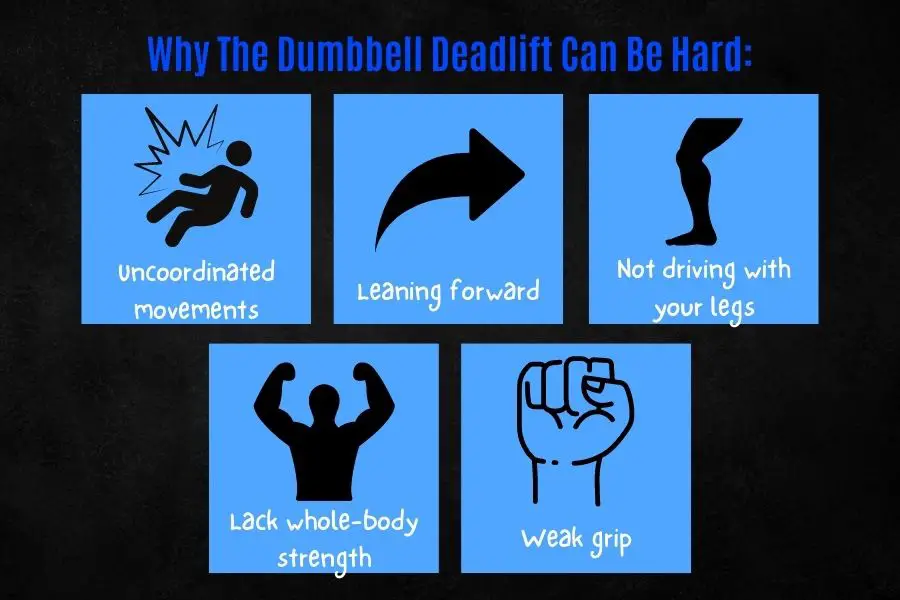
1) Uncoordinated upper and lower body movements.
All deadlift variations are technical compound exercises. They require coordinated movements between the upper and lower body to hoist the weight off the ground.
Furthermore, the dumbbell deadlift in particular requires even more coordination than the traditional barbell deadlift.
That’s because the dumbbells move independently from each other.
And this means your arms, legs, and back need to work together in one synchronous motion. If this isn’t done correctly, you’ll struggle to transmit all your strength into the dumbbells.
2) You’re leaning too far forward or backward.
Your head and upper back must not lean too far forward during the deadlift. If you do this, you’re shifting your center of gravity away from the feet.
As a result, you won’t be able to transmit 100% of your strength into deadlifting the dumbbells.
Instead- try sticking your buttocks out, sit back slightly, and keep a straight back. This will concentrate your center of mass directly onto your feet.
A good sign that you’re doing this correctly is if you feel balanced at the bottom starting position of the deadlift.
The opposite is also true. If you feel unbalanced, then you may be leaning too far forwards or backward.
Additionally, the dumbbell should travel upwards in a straight path rather than a curved trajectory.
3) You aren’t driving with your legs.
A common deadlift mistake is not utilizing your legs sufficiently. Remember- the deadlift is similar to the squat and is primarily a leg and back exercise.
Although your arms should be used to help pull the dumbbells up, the majority of the force should be generated from the legs.
This can be achieved by driving your legs into the ground to push out your hips.
If you fail to do this, you may find your deadlift strength significantly impacted.
4) Lack of whole-body strength.
If you’ve just started weight training, then you shouldn’t be too alarmed by a low dumbbell deadlift.
Although this exercise primarily engages the legs and back, your entire body is involved in some way or another to stabilize the movement.
Therefore the dumbbell deadlift is a big compound movement that works the entire body.
And if one or more muscle groups is lacking in strength, then your deadlift weight will be compromised.
5) You’ve got a weak grip.
Grip strength is a major contributor to how much weight you can deadlift.
If you can’t hold the dumbbells, then how can you expect to lift the weight off the floor?
Furthermore, grip strength is particularly important in the dumbbell deadlift, since each dumbbell needs to be stabilized independently from the other. This will naturally improve over time as you gain more deadlifting experience.
You can also check out my other post for a timeline of muscle gain!
5 Tips To Improve Your Dumbbell Deadlift Weight
Here are 5 tips to improve your dumbbell deadlift:
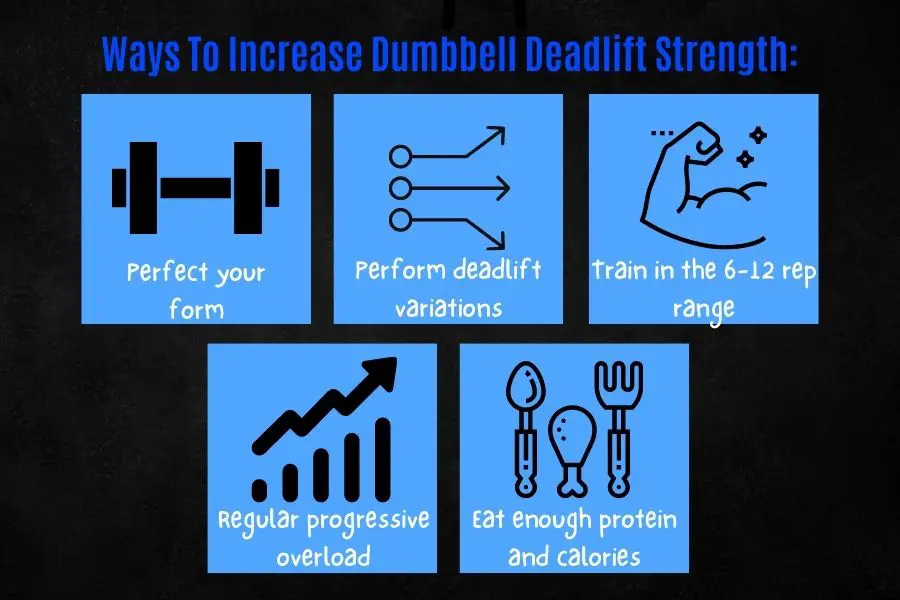
1) Learn and practice the correct dumbbell deadlifting form.
The only way to improve your deadlifting form and technique is with practice. The more work your legs, the stronger they will get.
But make sure you don’t overtrain them either. 2-4 intense sessions per week are ideal.
Additionally, you should practice with lighter loads. Once you’ve mastered your form and gained confidence, you can progressively increase weight.
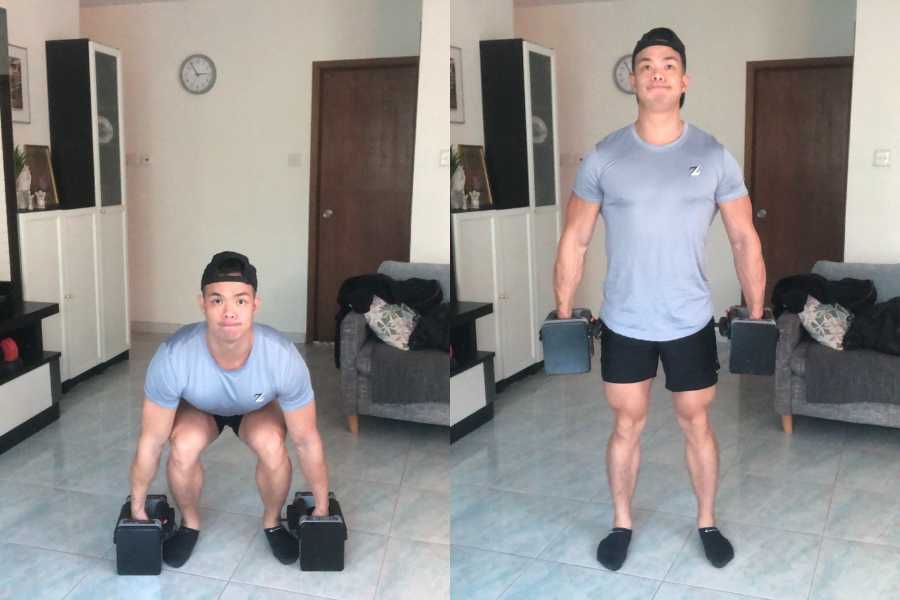
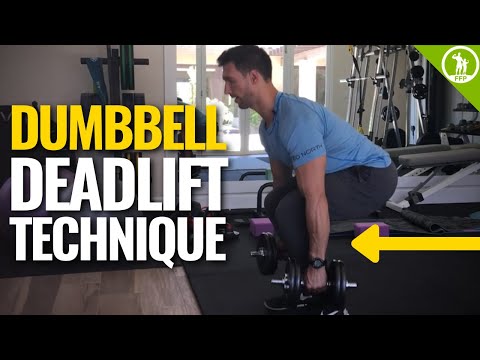
Here’s how to do the dumbbell deadlift with perfect form:
2) Perform deadlift variations and accessory exercises.
Since the dumbbell deadlift is a whole-body exercise, it makes sense to perform a variety of exercises to train all the muscles involved in the movement.
The best way to improve your dumbbell deadlift is to practice deadlifting with dumbbells. But different variations and accessory exercises can also indirectly improve your deadlift:
- Stiff-legged deadlift. Shifts emphasis from the quads to the hamstrings to facilitate hip extension in the upper portion of the deadlift movement.
- Dumbbell squat. Places an even higher emphasis on the quads to facilitate leg extension in the lower portion of the deadlift movement. You can check out my other post for squat variations for beginners.
- Goblet squat. Similar principle to the dumbbell squat but easier to lift heavier dumbbells.
- Dumbbell bent-over-rows. Trains the back muscles which are important for the final phase of the deadlift when your back becomes upright (i.e. the “lockout”).
- Lateral raises. Trains the deltoids which are important for stabilizing the dumbbells as you go through the deadlift movement.
3) Stay within the 6 to 12-rep range to maximize deadlift strength.
To increase your deadlift strength, it’s best to lift heavy and within the range of 6-12 reps per set. If you lift for, say 20+ reps per set, you’re most likely going to train your muscular endurance rather than strength.
And as a result, you’re deadlift weight progression will become slower.
Of course, for this to work, you’ll also need to choose a weight that challenges your muscles for 6-12 reps.
Therefore if you want to keep progressing with the dumbbell deadlift, you must have access to heavy dumbbells.
4) Progressive overload regularly.
Progressive overload involves adding weight to your deadlift. This is one of the most effective ways to increase strength in any lift.
However, it’s essential that you only add weight when you can perform the lift with good form.
Therefore my advice to improve your deadlift would be to first decrease the weight by 10%, master your form, then proceed with adding 5-10% weight increments each week thereafter.
Indeed, once you’ve mastered your form, you’ll likely find yourself progressing rapidly and making 5-10% weight increases each week without issue.
In fact, you may even outgrow your current dumbbells fairly rapidly.
5) Eat enough daily protein and calories.
The deadlift may be the single biggest exercise you can perform. And this makes it great for all-around strength and size gains.
But for gains to happen, you need to effectively fuel the muscle growth process.
And this means you should be eating enough protein and calories…. every day.
A good target to aim for is 1g of protein per pound of body weight and a 5-15% caloric surplus. This allows you to pack on maximum muscle mass with minimal fat gains.
Now, many people (especially beginners) struggle to eat this much food. I recommend logging your calorie intake and slowly increasing this day by day.
For tips on how to do this, you can check out my skinny guy’s guide to bulking up at home.
Other Weight Standards For Dumbbell Deadlift Muscles
The dumbbell deadlift is a full-body exercise with an emphasis on the legs and back. Here are weight standards for other exercises that hit similar muscle groups:
- Dumbbell squat– alternative to the dumbbell deadlift for training the legs.
- Goblet squat – another effective dumbbell leg exercise for targeting the quadriceps.
- Dumbbell row– compound pulling movement that works the lats, rhomboids, posterior delts, and traps.
- Dumbbell reverse fly– isolation exercise that works the rhomboids and posterior delts.
You can also check out my other article for the world’s heaviest deadlifts!
Conclusion
I’ve shared my dumbbell deadlift weight standards for people of different genders, body weights, and training levels.
You’re lifting a respectable amount of weight if you meet or exceed these standards.
I’ve also shared my tips on how to improve a sub-average dumbbell deadlift!
You may also be interested in the downloadable Kalibre Blueprint PDF which details exactly how I gained 40lbs of lean muscle (it’s 100% free!). It details the exact exercises and nutrition (with printables) I used to go from skinny to ripped!